
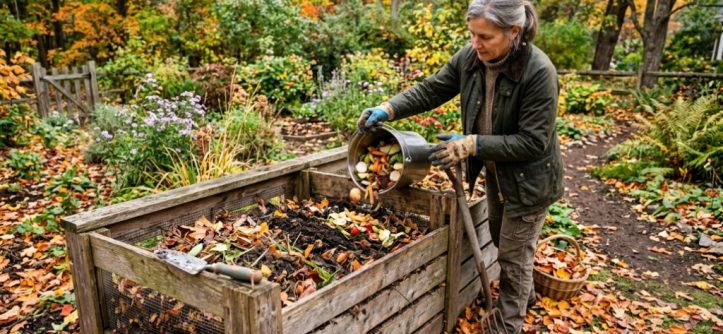
When the first hard freeze hits, most compost piles go dormant. The microbial activity that breaks down kitchen scraps and yard waste slows to a crawl, and many gardeners simply write off composting until spring. That assumption costs you months of finished compost. Tumbler designs change that equation because they can be moved, insulated, and turned even when the ground is frozen. If you are weighing whether this approach works in a cold climate, the real question is how the F2C outdoor compost tumbler handles cold weather compared with a standard open pile. The answer depends on mass, moisture, aeration, and a few habits that matter more in winter than in summer.
Quick Answer
A tumbler does not generate heat on its own. In cold weather, it retains heat only if it holds enough active material, stays moist but not soggy, and gets turned regularly. A sealed, dark-colored tumbler with a full load can stay active well into freezing temperatures and may keep working through mild frosts, but sustained deep cold will slow decomposition regardless of design. Expect slower finished compost in winter and plan for a spring finish rather than a mid-winter one.
Key Takeaways
- Tumblers slow down in cold weather just like open piles; enclosure helps but does not eliminate the temperature effect.
- Volume matters more than any single feature. A mostly empty tumbler loses heat quickly and stalls.
- Moisture balance is the most common winter failure point; frozen clumps and dry pockets both stop breakdown.
- Turning adds oxygen and redistributes heat, but over-turning a cold, small batch can cool it further.
- Four-season composting works best as a two-stage system: an active tumbler plus a finishing bin or pile.
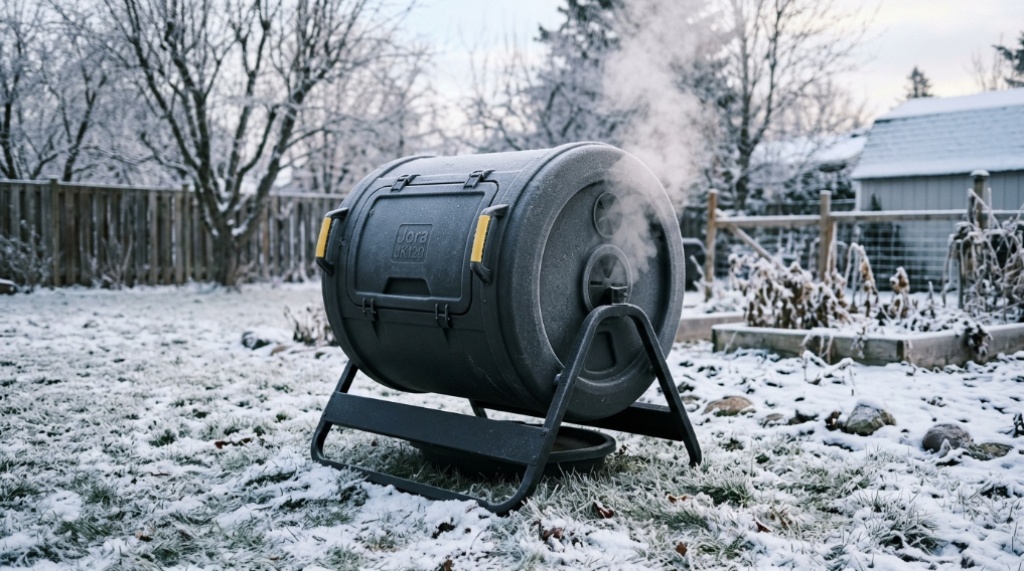
How Cold Weather Actually Affects Compost
Composting depends on microorganisms that stay active within a temperature range. When internal temperatures drop, their metabolism slows, and decomposition effectively pauses below freezing. This is true for open piles, bins, and tumblers alike. What changes between designs is how well each one holds the heat the microbes produce.
Three factors drive internal temperature:
- Mass. A large volume of material insulates itself. A small batch loses heat to the surrounding air quickly.
- Moisture. Microbes need a damp environment, roughly like a wrung-out sponge. Too dry and activity stops; too wet and the material goes anaerobic or freezes into a solid block.
- Oxygen. Aerobic breakdown generates heat. Without air, the process shifts to slower anaerobic decomposition that produces odor instead of warmth.
Enclosed tumblers help with two of these: they reduce heat loss through the walls and they exclude rain and snow that would otherwise oversaturate the contents. They do not create heat. That distinction matters because it explains why some gardeners report a tumbler “working all winter” while others see nothing happen. The difference is usually management, not the container.
What Changes When You Use a Tumbler in Winter
A tumbler’s main winter advantage is that it can be turned without digging into frozen ground. With an open pile, turning in January often means chopping through an ice crust or abandoning the task entirely. A tumbler lets you rotate the contents with a handle, which reintroduces oxygen and mixes warmer inner material with cooler outer material.
The trade-off is volume. Most residential tumblers hold far less material than a freestanding pile, so they cool faster per unit of mass. To compensate, keep the tumbler as full as practical during cold months and add material in batches rather than a handful at a time, To ensure your garden thrives year-round alongside your soil enrichment efforts, check out these Easy Outdoor Plant Maintenance Strategies Used in Charlotte, NC.
Practical adjustments for winter:
- Position the tumbler in direct sun and, if possible, against a south-facing wall or fence to reduce wind exposure.
- Chop kitchen scraps and yard waste into smaller pieces before adding them; smaller particles decompose faster and blend more evenly.
- Avoid adding large frozen chunks, which can stall the whole batch.
- Keep a lid or cover on to prevent snowmelt from flooding the contents.
- A black or dark-colored drum absorbs more solar heat than a light-colored one.
Tumbler vs. Open Pile in a Four-Season Climate
Neither approach wins everywhere. The right choice depends on how much material you generate, how much space you have, and how much effort you want to invest in winter.
| Factor | Tumbler | Open Pile |
|---|---|---|
| Winter turning | Possible by hand, even in snow | Difficult once the surface freezes |
| Heat retention | Better per unit volume, limited by smaller size | Better at large scale due to mass |
| Moisture control | Enclosed, resists rain and snowmelt | Exposed, can become waterlogged or freeze solid |
| Capacity | Limited; needs frequent emptying | Large; handles volume with less management |
| Aeration | Easy to turn, but can be over-turned | Requires pitchfork work |
| Pest and animal access | Reduced with a sealed drum | Higher unless enclosed |
For most home gardeners in cold regions, the strongest setup is a combination: a tumbler for active kitchen and yard waste during the growing season and into early winter, plus a finishing pile or bin where partially decomposed material cures over the coldest months. This keeps the tumbler available for fresh material instead of holding a stalled batch all winter.
Common Winter Composting Mistakes
Most cold-weather failures trace back to a handful of avoidable errors. Recognizing them early saves a stalled batch.
- Letting the tumbler sit nearly empty. A quarter-full drum loses heat fast. Add material in larger batches and keep it topped up.
- Adding too much wet material at once. A large dump of soggy scraps can freeze into a block. Mix in dry, carbon-rich material like shredded leaves or cardboard as you go.
- Ignoring the carbon-to-nitrogen ratio. Winter batches tend toward kitchen scraps, which are nitrogen-heavy and wet. Balance them with browns to keep the pile porous and aerated.
- Turning too often. Each turn releases heat. In cold weather, turn less frequently, roughly once or twice a week rather than daily.
- Assuming a stalled tumbler is dead. Cold usually pauses activity rather than killing it. Once temperatures rise, breakdown can resume if moisture and oxygen are adequate.
What to Expect From Winter Decomposition
Even a well-managed tumbler will slow down in winter. Internal temperatures may stay above ambient, but reaching the hot, steaming phase typical of summer is unlikely unless the batch is large and well-insulated. That means finished compost from a winter batch usually arrives later than you would expect from a summer batch.
Realistic expectations:
- In mild winters, a full, active tumbler may keep processing material slowly with occasional turning.
- In hard-freeze regions, expect near-dormancy for weeks at a time, with activity resuming during thaws.
- Material added in late fall is more likely to finish in spring than in mid-winter.
- Curing in a separate bin over winter gives you finished compost sooner in spring than trying to force a single tumbler to do everything.
This is not a design flaw. It is the nature of biological decomposition in cold conditions. Planning around it produces better results than fighting it.
Frequently Asked Questions
Does a compost tumbler keep working below freezing?
Microbial activity slows dramatically below freezing, so a tumbler will not process material quickly in deep cold. A full, well-managed tumbler can stay active through mild frosts and resume during thaws, but sustained sub-freezing temperatures typically pause decomposition until conditions improve.
Should I keep adding kitchen scraps in winter?
Yes, but add them in small amounts and mix them with dry browns so the batch does not turn into a wet, frozen mass. If the tumbler is already stalled, you can store scraps in a sealed container outdoors or freeze them until conditions improve.
How full should a winter tumbler be?
As full as practical. Volume provides insulation, so a nearly empty tumbler loses heat quickly. Aim to keep it at least half full, and add material in batches rather than small daily handfuls.
Can I insulate a compost tumbler?
You can, using materials like straw bales, foam board, or a windbreak placed around the drum. Insulation reduces heat loss and blocks wind, but it will not create heat if the material inside is too wet, too dry, or too small in volume to generate it.
Why does my tumbler smell in winter?
Odor usually signals anaerobic conditions from excess moisture or poor aeration. Add dry browns, turn the contents to introduce oxygen, and avoid adding wet material without balancing it. Frozen material that thaws can also release odor if it was too wet when it froze.
Is a tumbler better than a pile for cold climates?
Not universally. A tumbler is easier to manage and turn in winter, while a large open pile holds heat better due to mass. Many cold-climate gardeners use both: a tumbler for active material and a larger pile or bin for bulk and curing.
Conclusion
Cold-weather composting is less about finding a magic container and more about managing mass, moisture, and oxygen through the seasons. A tumbler makes winter turning easier and resists rain and snow, but it still slows down when temperatures drop. The most reliable approach is to keep the drum reasonably full, balance wet scraps with dry browns, and use a second bin or pile for material that needs to cure over winter. Start with those habits and let the season set the pace rather than expecting summer-speed results in January.



Leave a Reply